
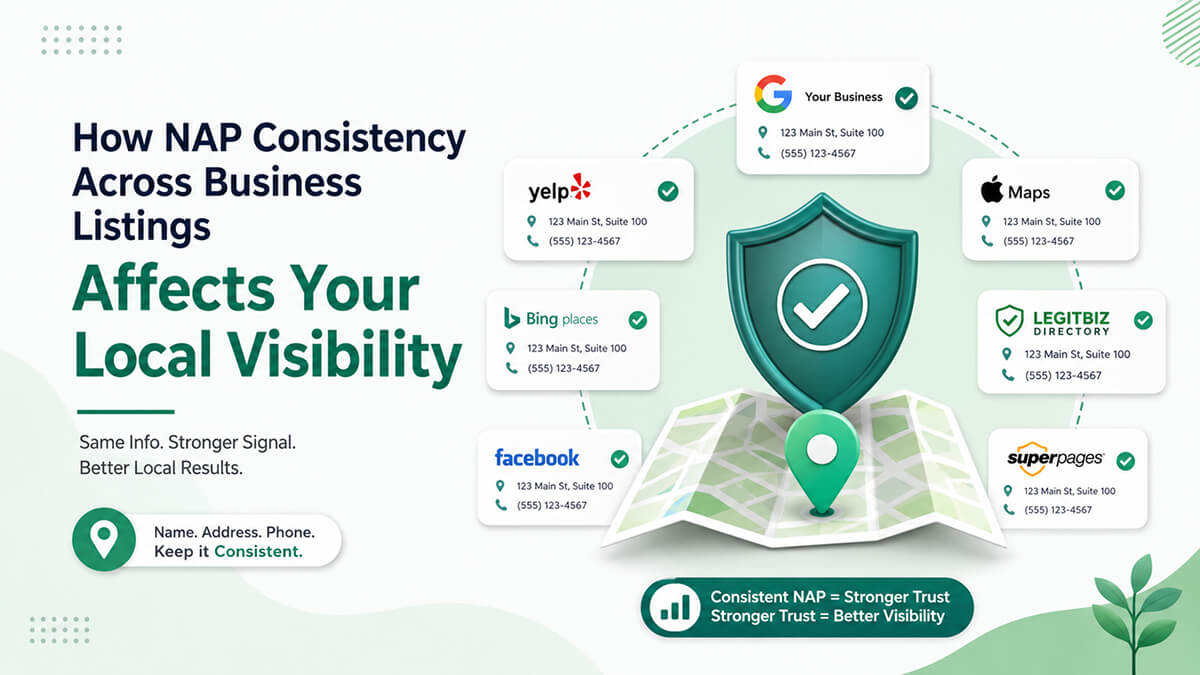
Small discrepancies in how your business information appears online are easy to overlook until they start costing you. A suite number missing here, an old phone number there, a slight variation in your business name between platforms these things add up in ways that aren’t always obvious until your local presence starts underperforming compared to competitors who’ve been more careful about this.
What NAP Consistency Actually Means
NAP stands for Name, Address, Phone Number. In local marketing, consistent NAP means that every time your business appears online directories, review sites, maps, local listings the same information appears in the same format.
This sounds simpler than it is. Most businesses accumulate inconsistencies naturally over time. You move offices. You change your number. You start using a DBA that’s slightly different from your legal name. Each change creates a window where old information persists somewhere while new information appears elsewhere, and search engines see the conflict.
Why Search Engines and AI Tools Care About This
Local search algorithms are trying to do one thing: connect users with real, accurately represented businesses nearby. When your information appears consistently across multiple independent sources, it reinforces that you’re exactly who you say you are, at the location you claim, reachable at the number you’ve listed.
Inconsistency doesn’t necessarily get you penalized, but it introduces uncertainty. Uncertain signals produce weaker visibility. When two competitors are otherwise comparable, the one with cleaner citation data tends to show up more reliably in local results.
The Sources That Matter Most and How to Prioritize Them
Not all listings carry equal weight. Google Business Profile is your most important single listing make sure it’s accurate, claimed, and fully completed. After that, the major data aggregators are worth your attention. Getting accurate information into those systems can push corrections downstream to dozens of smaller directories automatically.
Then focus on directories your actual customers use in your specific industry. In most verticals, there are two or three review and listing sites where people look before making a decision. Being listed accurately there and on established business directories like legitbizdirectory.com where location and category filtering help customers find you covers most of your bases efficiently.
The goal isn’t perfect consistency overnight. It’s steady improvement toward a clean, reliable information footprint. Start by searching your business name and noting every variation you find, then work from the highest-traffic sources downward.
Frequently Asked Questions
Does a slight difference in address format really matter?
It can, especially in aggregate. One formatting difference on one site is unlikely to matter much by itself. But widespread inconsistency across many sources compounds over time. Search engines weigh the consensus across sources, so the more those sources agree, the stronger the collective signal.
What if my business name changed do I need to update every listing?
Yes, ideally starting with the highest-traffic sources first. Google, Yelp, and Apple Maps should be updated immediately. Work outward from there. Many directory sites have a claim process that lets you update information directly. This is worth the time, especially after a rebrand.
Should my address always match exactly, even if Google formats it differently?
Use the format that matches your official USPS address you can verify this at usps.com. Match that format consistently across your listings. Don't worry too much about how Google's display interface formats the address; focus on what you submit and keep it uniform.
Can data aggregators fix my citation inconsistencies automatically?
Aggregators like Data Axle and Foursquare distribute your information to many downstream directories. Correcting your data with them pushes changes outward, but it's not a complete fix some directories don't pull from aggregators and require manual corrections.
How long should I spend on citation maintenance each month?
For most single-location small businesses, thirty to sixty minutes per quarter is enough to catch major issues. If you've recently moved or changed your contact information, dedicate time immediately to pushing those updates out before the old information becomes entrenched across the web.